
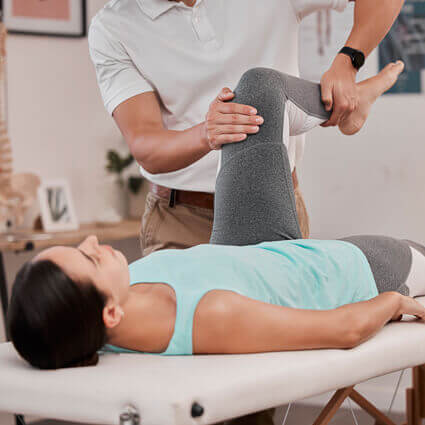
 If your leg pain or sciatica keeps coming back, it is usually because the true cause was never properly identified or corrected. In many cases, the pain is not actually coming from the leg itself. It often originates in the lower spine or sacroiliac joint, where spinal nerves can become irritated due to misalignment, disc stress, or joint dysfunction. If that underlying irritation remains, the nerve continues to send pain signals down the leg.
Leg pain that travels from the lower back into the thigh, calf, or foot is commonly called sciatica. This happens when one or more of the lumbar nerve roots that form the sciatic nerve are irritated. That irritation can be caused by misaligned vertebrae in the lower lumbar spine, disc degeneration, disc bulging, arthritis, or pelvic imbalance. In some cases, sacroiliac joint dysfunction can refer pain into the back of the thigh and mimic sciatica.
When treatment only focuses on stretching the leg or masking pain with medication, the source of nerve irritation may remain unchanged. As long as the structural stress in the spine or pelvis continues, the symptoms often return. The key to lasting relief is identifying exactly where the nerve irritation is coming from and correcting that specific problem.
For patients in Orillia, Ontario dealing with recurring leg pain, proper assessment and targeted chiropractic adjustments can address the underlying spinal or pelvic cause rather than temporarily covering up symptoms.
Why Recurring Leg Pain Is So Often Misunderstood
I see this pattern regularly in my practice. Someone experiences pain running down the leg. They stretch the hamstring. They try anti-inflammatory medication. They rest. The pain improves for a while. Then it comes back.
The frustration builds because it feels unpredictable. Many people are told they simply have sciatica and that it may flare up from time to time. But the word sciatica only describes a symptom pattern. It does not explain the mechanism.
Sciatica means irritation of the sciatic nerve or its contributing nerve roots. The sciatic nerve forms from spinal nerves exiting the lower lumbar spine, most commonly at L4, L5, and S1. If those segments are not functioning properly, the nerve can become inflamed or compressed. When that happens, pain can radiate along the path of the nerve.
Not all leg pain is true sciatic nerve involvement. Sacroiliac joint dysfunction can create referral pain into the back of the thigh, typically stopping above the knee. That distinction matters. If the wrong structure is treated, the results will not last.
As a chiropractor in Orillia, Ontario, with over 25 years of experience in gait analysis, biomechanics, and neurology, I focus on determining exactly which structure is responsible. Without that clarity, care becomes generalized instead of specific.
Common Structural Causes of Recurrent Leg Pain
There are several spinal and pelvic factors that commonly contribute to recurring leg pain.
One of the most frequently missed causes is misalignment in the lower lumbar spine. When vertebrae at L4 or L5 shift out of proper alignment, even slightly, they can narrow the space where spinal nerves exit. Over time, this mechanical stress can irritate the nerve root.
Disc degeneration and disc herniation are also important contributors. When discs lose height or integrity, the load distribution in the spine changes. This can increase pressure on nerve roots, particularly during bending or prolonged sitting.
Accelerated spinal arthritis often develops when misalignment has been present for years. Abnormal joint motion leads to uneven wear. As arthritic changes progress, joint swelling and bone overgrowth can further narrow nerve pathways.
Sacroiliac joint dysfunction is another common source. The sacroiliac joints connect the sacrum to the pelvis. If one side becomes restricted or rotated, it can create asymmetrical loading across the pelvis and lower spine. This imbalance may irritate surrounding nerves and refer pain into the thigh.
An anatomical short leg can add another layer of stress. A true leg length discrepancy creates a chronic tilt in the pelvis. That tilt increases pressure on one side of the lumbar spine and can accelerate disc and joint degeneration. In my clinical experience in Orillia, Ontario, this is an often overlooked contributor to chronic sciatica patterns.
Each of these issues has a different mechanical cause. That is why a one size fits all approach does not work.
Assessing the Spine and Pelvis to Identify the Source of Leg Pain
When someone comes into Wihlidal Family Chiropractic in Orillia with recurring leg pain, the first priority is not to adjust immediately. The first priority is to assess.
The process begins with posture analysis. I look for visible asymmetries in shoulder height, pelvic tilt, spinal curves, and head position. Poor posture often reflects deeper structural imbalances. For example, a dropped pelvis on one side may indicate an anatomical short leg or sacroiliac dysfunction.
Next, I perform a detailed spinal examination to identify areas of restricted motion or subluxation. I palpate the lumbar spine and sacrum, feeling for joint fixation, tenderness, and abnormal alignment. Restricted segments often correspond with nerve irritation patterns.
Leg length evaluation is also essential. I assess both functional and anatomical leg length differences. A functional short leg may be due to pelvic rotation. A true anatomical short leg involves actual bone length difference. Both can influence spinal loading, but the corrective strategy differs.
Muscle testing provides additional information. Nerve irritation can weaken specific muscle groups. For example, involvement of certain lumbar nerve roots may affect ankle dorsiflexion strength or reflexes. These neurological findings help pinpoint the level of irritation.
Orthopedic testing is performed to reproduce or relieve symptoms in controlled positions. Certain movements that increase disc pressure can aggravate nerve pain if a disc is involved. Other tests stress the sacroiliac joint. The pattern of response guides the diagnosis.
In some cases, X-rays are used to evaluate structural alignment, disc height, degenerative changes, or confirm an anatomical leg length discrepancy. Imaging is not used routinely, but when indicated, it provides objective structural insight.
This thorough assessment allows me to determine whether the pain is coming from a lumbar disc issue, facet joint misalignment, sacroiliac dysfunction, leg length discrepancy, or a combination of factors.
Without this step, treatment is guesswork. With it, care becomes specific and targeted.
Chiropractic Adjustments Used to Correct the Cause of Leg Pain
Once the source of nerve irritation is identified, the adjustment strategy is tailored to that cause. It is important to understand that these adjustments are not for leg pain itself. They are designed to correct the structural issue creating the nerve irritation.
Lumbar Specific Adjustment
If assessment shows a misalignment at L4 or L5 contributing to nerve irritation, a specific lumbar adjustment may be performed.
The patient is positioned on their side in a way that isolates the affected segment. I stabilize the upper body while contacting the involved vertebra. A precise, controlled thrust is delivered to restore motion and alignment.
The purpose of this adjustment is to reduce joint fixation, improve spinal mechanics, and decrease mechanical stress on the exiting nerve root. When pressure on the nerve decreases, inflammation can settle and pain traveling down the leg may improve.
This is not a generalized twisting motion. It is targeted to a specific vertebral level based on examination findings.
Sacroiliac Joint Adjustment
If the sacroiliac joint is identified as the primary source, the adjustment approach changes.
The sacrum or ilium may be misaligned relative to the pelvis. With the patient positioned appropriately, I apply a controlled adjustment to restore proper joint motion.
Correcting sacroiliac dysfunction helps level the pelvis and reduce asymmetrical stress on the lumbar spine. When pelvic balance improves, secondary nerve irritation may resolve.
In my experience in Orillia, Ontario, sacroiliac dysfunction is frequently misdiagnosed as simple sciatica. Treating the correct joint makes a significant difference in outcomes.
Pelvic and Foundation Correction
When leg pain is linked to long-standing postural imbalance or anatomical short leg, adjustments alone may not be sufficient.
In these cases, I address the pelvic misalignment and evaluate whether a heel lift is necessary to correct a true leg length discrepancy. Balancing the foundation reduces chronic asymmetric loading of the lumbar discs and joints.
This approach is especially important for patients who have had repeated flare-ups over many years. Without correcting the underlying tilt, the spine continues to compensate.
Each adjustment is chosen based on the root cause identified during assessment. That specificity is what allows chiropractic care to move beyond temporary symptom relief.
When to Seek Professional Care for Leg Pain in Orillia, Ontario
Not all leg pain resolves on its own. If pain persists beyond a few days, worsens, or is accompanied by numbness, tingling, or weakness, a professional evaluation is appropriate.
Progressive weakness in the foot or difficulty walking requires timely assessment. Severe, unrelenting pain that interferes with sleep or daily function also warrants examination.
As a chiropractor in Orillia, Ontario, I focus on identifying whether the pain pattern matches nerve root irritation, disc involvement, sacroiliac dysfunction, or biomechanical imbalance. Proper clinical reasoning determines the appropriate course of care.
Assessment matters because the spine is a mechanical structure. When that structure is imbalanced, nerves are vulnerable to irritation. Simply waiting for symptoms to disappear does not correct the mechanical stress causing them.
Nightly and Weekly Action Plan to Support Recovery
While structural correction is central, supportive habits also play a role.
At night, sleeping position matters. Avoid prolonged stomach sleeping, which increases lumbar extension stress. Side sleeping with a pillow between the knees can help maintain pelvic alignment. Back sleeping with a small pillow under the knees may reduce lumbar disc pressure.
During the week, avoid prolonged sitting without breaks. Sitting increases disc pressure, especially in the lower lumbar spine. Standing and moving regularly reduces cumulative stress.
Pay attention to posture. Slouched sitting shifts load onto the discs and posterior joints. Maintaining a neutral spine position reduces strain.
If an anatomical short leg is present and a lift has been prescribed, consistent use is important. Inconsistent correction allows the pelvis to revert to its tilted position.
These supportive measures reinforce the structural corrections achieved through chiropractic adjustments in Orillia, Ontario.
Final Thoughts
Recurring leg pain is rarely random. In most cases, there is a structural reason the nerve continues to be irritated. Whether that source is lumbar misalignment, disc degeneration, sacroiliac dysfunction, or an anatomical leg length discrepancy, identifying the cause is the first step toward lasting relief.
You now understand that sciatica describes a symptom pattern, not a diagnosis. The true solution lies in determining where and why the nerve is being stressed.
If you are dealing with persistent leg pain in Orillia, Ontario, a thorough assessment can clarify the root cause and guide targeted correction.
If you are ready to address the underlying cause of your leg pain and work toward lasting relief, contact Wihlidal Family Chiropractic in Orillia to schedule a comprehensive evaluation.
CONTACT US
Frequently Asked Questions
How do I know if my leg pain is true sciatica?
Can a chiropractor in Orillia help with recurring sciatica?
What if my MRI showed a disc bulge?
How long does it take to correct recurring leg pain?
Could a short leg be causing my sciatica?
If you are experiencing persistent leg pain or sciatica in Orillia, Ontario, schedule an assessment to determine the exact cause and begin targeted care designed for long term relief.
Dr. Whitney Wihlidal
Wihlidal Family Chiropractic
15 Matchedash St N
Orillia, ON L3V 4T4
Tel: (705) 325-6425