
Dr. Whitney Wihlidal, Chiropractor in Orillia, Ontario
 Knee pain is often not just a problem in the knee itself. In many cases, it is caused by poor alignment and uneven load distribution that starts at the foot. When the foot rolls inward too much, or when the arch collapses or remains too rigid, the lower leg rotates inward. That rotation transfers directly into the knee joint and increases stress on the cartilage and surrounding structures.
Over time, this repeated stress leads to irritation, discomfort, and in some cases contributes to degenerative arthritis. This is why knee pain often worsens with walking, standing, or climbing stairs. The joint is being loaded unevenly with every step.
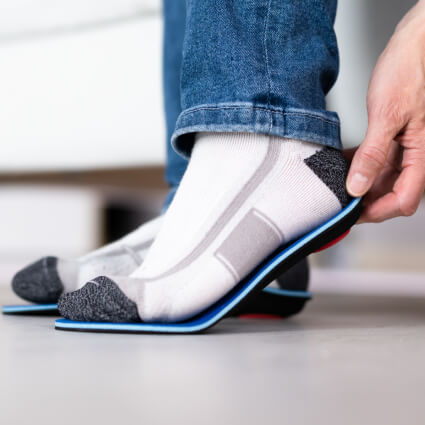
Custom foot orthotics can help by stabilizing the foot and improving alignment from the ground up. By controlling excessive foot movement and reducing rotational forces, orthotics decrease the amount of stress that reaches the knee. This can lead to reduced pain, improved function, and less strain on the joint over time.
However, orthotics are only effective when the knee pain is actually caused by foot mechanics. Identifying whether the root cause is coming from the foot or from structural damage within the knee itself is the key step in determining whether orthotics are the right solution.
Understanding Why Knee Pain Is Often Misunderstood
If you are dealing with chronic knee pain, it is frustrating. You may have tried stretching, strengthening, or even rest, but the pain keeps coming back. This happens because the true cause is often not where you feel the pain.
In my clinical experience as a chiropractor in Orillia, Ontario, I see this pattern regularly. Patients focus on the knee because that is where the symptoms are, but the underlying issue often starts lower in the body.
The body works as a connected chain. When one part is not functioning properly, it affects everything above it. The feet are the foundation. If that foundation is unstable, every step creates abnormal movement patterns that travel upward.
This is why knee pain caused by foot mechanics is frequently overlooked. It is also why many people continue to experience symptoms despite trying treatments that only target the knee itself.
Understanding this connection helps explain why some cases of knee pain respond extremely well to orthotics, while others do not.
How Foot Mechanics Affect Knee Pain
The most important concept to understand is alignment.
When your foot strikes the ground, it should absorb force and maintain a stable structure. If the foot rolls inward excessively, known as overpronation, the lower leg rotates inward as well. This rotation places additional stress on the knee joint.
Over time, that stress affects the cartilage, ligaments, and surrounding tissues. Instead of force being evenly distributed, certain areas of the knee absorb more load than they should.
In Orillia, Ontario, where many people spend long hours on their feet or stay active outdoors, this repetitive loading becomes a significant factor in chronic knee pain.
As a chiropractor focused on biomechanics, I look at how these forces move through the body. The key issue is not just movement, but how that movement is controlled.
When control is lost at the foot, the knee compensates. And that compensation leads to pain.
Key Strategies to Address Knee Pain Through Orthotics
Stabilizing the Foot to Reduce Knee Stress
The first step in addressing foot-related knee pain is stabilizing the foot.
Custom foot orthotics are designed to control excessive motion, particularly overpronation. When the foot is stabilized, the lower leg no longer rotates excessively with each step.
This directly reduces the rotational stress placed on the knee joint. Instead of absorbing abnormal forces, the knee can function in a more neutral and efficient position.
For patients in Orillia, Ontario, this often translates to less discomfort during daily activities like walking or standing.
Improving Alignment From the Ground Up
Alignment is not just about posture. It starts at the ground.
Custom orthotics improve how your foot interacts with the ground. They support the arch, guide proper movement, and help distribute weight more evenly.
When alignment improves at the foot, it carries upward into the knee, hip, and spine. This reduces the cumulative strain that builds up over time.
In my practice as Dr. Whitney Wihlidal, chiropractor in Orillia, Ontario, I have seen how correcting this foundation can change how the entire body moves.
Reducing Impact and Shock Transmission
Every step you take creates force. That force travels through your body.
Without proper support, much of that impact is transferred directly into the knee. Over time, this contributes to joint irritation and wear.
Orthotics provide shock absorption. They reduce how much of that force reaches the knee, especially during repetitive activities like walking or running.
This is particularly important for individuals with degenerative arthritis, where minimizing stress is critical.
Supporting Conditions Like Runner’s Knee and Arthritis
Orthotics are not just for general knee pain. They are particularly helpful in conditions where biomechanics play a major role.
This includes runner’s knee and patellofemoral pain syndrome, where improper tracking and alignment increase stress on the joint.
They are also beneficial in certain types of arthritis, where reducing uneven load distribution can slow progression and reduce discomfort.
However, it is important to understand that orthotics support function. They do not reverse structural damage.
When Knee Pain Is Coming From Your Feet
One of the most important steps is identifying whether your knee pain is actually related to your feet.
There are several clear indicators.
If your knee pain improves when you wear supportive shoes and worsens in flat footwear, this suggests that alignment is playing a role.
If you have flat feet, high arches, or notice your ankles rolling inward, these are structural signs that affect how force travels through your body.
Uneven shoe wear is another strong indicator. If one side of your shoe wears down faster, it reflects how your body is loading with each step.
You may also notice that your pain increases with prolonged walking, standing, or repetitive activity. This pattern often points to a mechanical cause.
In Orillia, Ontario, I assess these patterns regularly in my clinic. Identifying them early allows us to address the root cause rather than just managing symptoms.
Custom Orthotics vs Over the Counter Inserts
This is one of the most common questions I get as a chiropractor in Orillia, Ontario.
Over the counter inserts can provide general support and cushioning. For some people, this is enough to temporarily reduce discomfort.
However, they are not designed for your specific foot structure. They do not account for your arch type, gait pattern, or degree of pronation.
Custom orthotics are different.
They are built based on how your foot moves and how your body loads during walking. This allows for precise correction of alignment issues.
That precision is what makes the difference in chronic cases.
If your knee pain is caused by a specific mechanical issue, a generic insert may not address it effectively. It may feel comfortable, but it is not correcting the underlying problem.
Custom orthotics focus on improving function, not just adding cushioning.
When to Seek Professional Care
If you are dealing with ongoing knee pain, it is important to determine the cause.
If your symptoms are persistent, worsening, or interfering with daily activities, a professional assessment is necessary.
As Dr. Whitney Wihlidal, chiropractor in Orillia, Ontario, I perform detailed biomechanical and gait assessments to identify how your body is moving.
This includes analyzing how your heel strikes the ground, how your arch responds under pressure, and how your lower leg rotates.
This level of evaluation allows us to determine whether your knee pain is being driven by foot mechanics or by another issue within the knee itself.
Orthotics are most effective when they are part of a targeted plan based on accurate assessment.
If there is significant structural damage, instability, or advanced arthritis, additional interventions may be required.
The goal is not just relief. It is long term joint protection and better movement.
Nightly and Weekly Action Plan
If you suspect your knee pain may be related to foot mechanics, start by paying attention to patterns.
Notice how your knees feel in different types of footwear. Supportive shoes may reduce discomfort, while flat shoes may increase it.
Limit prolonged periods of standing or walking in unsupportive footwear. This reduces unnecessary strain while you are addressing the underlying issue.
Throughout the week, observe your movement. Pay attention to how your feet contact the ground and whether your ankles roll inward.
If symptoms persist, the next step is to seek a proper assessment. Identifying the root cause early allows for more effective intervention.
Consistency is important. Small changes in alignment, repeated over thousands of steps, create meaningful improvements over time.
Final Thoughts
Knee pain is not always a knee problem. In many cases, it is a result of poor alignment and uneven load distribution that starts at the foot.
Understanding how foot mechanics influence the knee gives you a clearer picture of what is actually causing your symptoms. This allows you to make more informed decisions about your care.
Custom foot orthotics can be a powerful tool when the root cause is mechanical. They stabilize the foot, improve alignment, and reduce stress on the knee with every step.
But the key is proper assessment.
If you are dealing with chronic knee pain or arthritis, the next step is to determine whether your feet are contributing to the problem.
Dr. Whitney Wihlidal, chiropractor in Orillia, Ontario, provides detailed biomechanical assessments to identify the root cause of your pain and guide the right treatment approach.
If you are ready to stop guessing and start addressing the source of your knee pain, book an assessment in Orillia today and take the first step toward lasting relief.
Dr. Whitney Wihlidal
15 Matchedash St. N.
Orillia ON L3V 4T4
(705) 325-6425
Frequently Asked Questions
Q: Can orthotics really help knee pain?
A: Yes, if the knee pain is caused by poor foot mechanics, orthotics can reduce stress on the knee by improving alignment and controlling excessive movement.
Q: How do I know if my knee pain is coming from my feet?
A: Signs include pain that improves with supportive shoes, flat feet or high arches, uneven shoe wear, and discomfort that increases with walking or standing.
Q: Are custom orthotics better than store bought inserts?
A: Custom orthotics are designed for your specific foot structure and movement patterns, making them more effective for correcting mechanical issues.
Q: Can orthotics fix arthritis in the knee?
A: Orthotics cannot reverse arthritis, but they can reduce stress on the joint and help manage symptoms by improving alignment.
Q: When should I see a chiropractor for knee pain in Orillia?
A: If your pain is persistent, worsening, or affecting daily activities, a chiropractor like Dr. Whitney Wihlidal in Orillia, Ontario can assess whether foot mechanics are contributing to your symptoms.